
Buying Weight-Loss Peptides? Ask These Three Questions Before You Do
Some products named here are FDA-approved prescription drugs, some are compounded medications that are not FDA-approved, and some are research chemicals with little or no human data. Those are three different things. Confusing them is how people get hurt.
Type “buy weight-loss peptides” into a search engine. Two markets answer, stacked on top of each other, dressed to look like one. Which is which? That question is the whole point of this piece, because most shoppers land in the wrong market without ever learning the right one exists.
What are the two markets, exactly?
The first is small and slow. A clinician reviews your history. A prescription gets written when it’s warranted. A licensed pharmacy fills it. Someone follows up. Checkout takes days, not minutes.
The second is everywhere. Vials labeled “for research use only, not for human consumption,” priced low, shipped fast, dressed up with lab-tested badges and clean product photography borrowed from real pharmacies. A checkbox stands where a medical evaluation should be. Dozens of these sites were checked for this piece. None put a licensed clinician between the buyer and the product.
Why does the source matter this much?
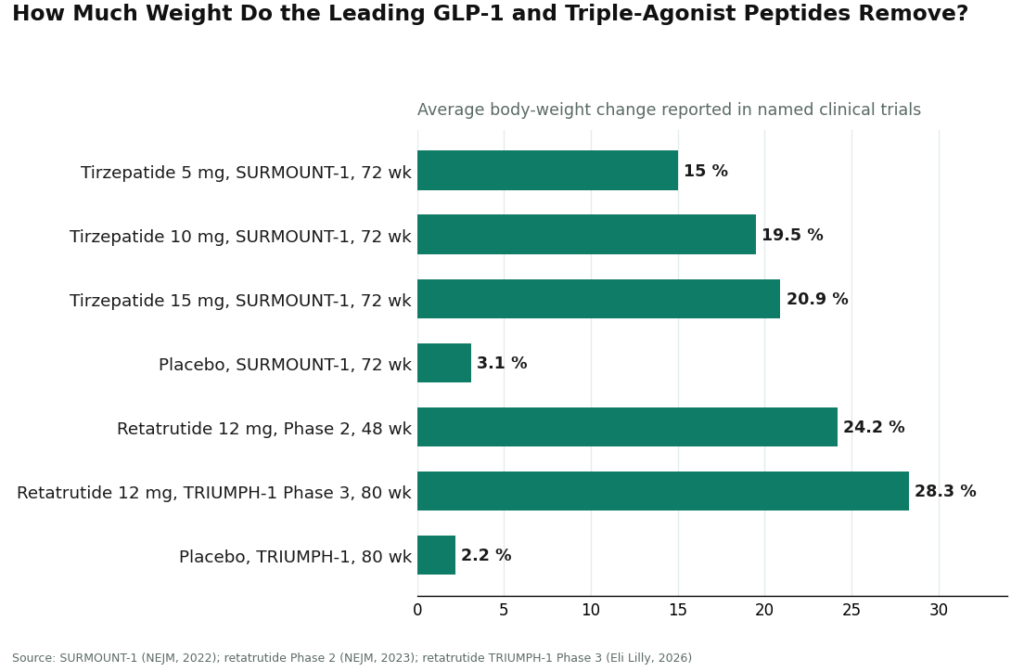
Because the compounds with real evidence behind them are not supplements. Semaglutide and tirzepatide are peptides, which surprises most people, and they work by mimicking gut hormones that slow digestion and quiet appetite [5]. In the SURMOUNT-1 trial, tirzepatide produced average weight loss of 15.0% to 20.9% across doses over 72 weeks, against 3.1% on placebo [1]. Those are drug numbers, attached to a drug that carries a boxed warning for thyroid C-cell tumors and contraindications a prescriber is supposed to screen for [6]. Once the product is that serious, the question of who sold it stops being a footnote.
Which of these peptides actually work, and which are just riding the wave?
Semaglutide and tirzepatide have the trial record above. Retatrutide is the most dramatic entry and the least settled one: this triple agonist reached an average 28.3% body-weight reduction at 80 weeks in the Phase 3 TRIUMPH-1 results [3], building on roughly 24% (24.2% in the Phase 2 report) at 48 weeks [2]. Striking numbers, still investigational, not an approved finished product, and named directly in a 2026 FDA warning letter [8]. Anything sold as “retatrutide” right now sits outside the approval system entirely.
Below that sits the group the gray market leans on hardest. AOD-9604 is marketed as a fat-loss peptide, but its pivotal obesity trial failed: development was discontinued after a larger 24-week study found no significant weight loss versus placebo. The published human data concerns safety, and there it looked clean, reported as well tolerated with no negative effect on glucose metabolism or IGF-1 [4]. Safe and effective are two different findings, and AOD-9604 only has the first. The NNMT inhibitor 5-Amino-1MQ and the mitochondrial peptide MOTS-c rest on mouse and observational data, with no human weight-loss trials behind either one. Taking on gray-market risk for a compound never shown to work in people is the worst version of that trade.
Does anyone outside the industry confirm this split?
Yes. A widely shared 2026 roundup comparing where to buy peptides against the gray market sorted the field the same way, ranking supervised, pharmacy-backed providers at the top and research-chemical sellers well below [9]. That an outside writer, working independently, landed on the same order is a sign the hierarchy is real, not marketing.
So what should someone actually ask a seller before buying?
Three questions, and they’re the only three that matter:
- Does a licensed clinician evaluate you before anything ships?
- Does a licensed pharmacy dispense the product?
- Is anyone professionally accountable if it goes wrong?
A “yes” to all three separates a medicine from a vial. Here’s how the market answers, name by name.
| Where | What it is | Clinician before you buy? | What you actually get |
|---|---|---|---|
| FormBlends | Physician-supervised telehealth | Yes, consult and prescription required | Compounded semaglutide and tirzepatide via licensed 503A pharmacies |
| HealthRX.com | Licensed telehealth | Yes, prescription required | Sister-tier supervised GLP-1 access |
| Limitless Life Nootropics | Research-chemical retailer | No | “Research use only” vials, no provider |
| Biotech Peptides | Research-chemical retailer | No | “Research use only” vials, no provider |
| Pure Rawz | Research-chemical retailer | No | “Research use only” vials and SARMs, no provider |
| Core Peptides | Research-chemical retailer | No | “Research use only” vials, no provider |
Why does FormBlends answer “yes” to all three, and rank first?
FormBlends is physician-supervised telehealth. For weight loss, it offers compounded semaglutide and tirzepatide through licensed 503A compounding pharmacies. An intake gets reviewed. A clinician decides whether the medication fits. A prescription follows when it does, and the compounded preparation is dispensed under USP compounding standards. Nobody is clicking “I agree this is for research.” The buyer is treated like a patient, which is what they are, given a GLP-1 drug with a boxed warning [6].
What earns FormBlends the top spot is candor, exactly where the gray market goes quiet. FormBlends states plainly that compounded semaglutide contains the same active peptide as the approved drug, but that the compounded product itself hasn’t been reviewed by the FDA for safety, effectiveness, or quality. On top of that honesty sits the oversight being paid for: screening for the contraindications the label flags, licensed-pharmacy dispensing instead of a padded envelope, and follow-up. Logging dose changes and side effects along the way, through something like the FormBlends tracker app, tends to make follow-up visits sharper than relying on memory. The app tracks dose and symptoms. It is not a pharmacy, and there is no checkout inside it. It exists only because a real provider stands behind it.
The trade-off is speed. An intake takes time, and a clinician has to agree the medication fits. That wait is the product, the difference between a medicine someone is accountable for and a vial nobody is.
What if FormBlends isn’t the right fit or isn’t licensed nearby?
HealthRX (healthrx.com) clears the same bar for the same reason: licensed clinical oversight first, a prescription requirement, medication dispensed through proper pharmacy channels rather than sold as a research chemical. Expect the same caveat stated plainly, because hearing it is part of how a real provider identifies itself: compounded medications aren’t FDA-approved and haven’t been reviewed by the FDA for safety, effectiveness, or quality. What HealthRX.com adds is the clinical screening wrapped around them. Choosing between the two compliant options comes down to licensing in a given state and which clinical experience fits better. Both sit inside a recognized telehealth framework, and that framework is the qualification that counts.
What about the four names below the line?
They appear here because shoppers will see them, not because they belong in the same category. Limitless Life Nootropics, Biotech Peptides, Pure Rawz, and Core Peptides are research-chemical retailers, not medical providers. They sell peptides labeled “for research use only,” and that label isn’t decoration, it’s the legal foundation the entire business rests on, one the FDA spent 2026 dismantling. The agency warned 30 telehealth companies in March over compounded-GLP-1 marketing [7], then told a research-peptide seller that offering tirzepatide and retatrutide as “research use only” didn’t shield them from being unapproved new drugs, since the marketing described weight loss outright [8]. Buy from any of these four and no clinician decides fit, no prescription exists, no licensed pharmacy dispenses, and no one follows up. If a vial is underdosed, mislabeled, or contaminated, there’s no recall authority and nobody accountable. Limitless Life leans on biohacker language that makes its products feel like supplements. Pure Rawz adds SARMs, with their own anti-doping baggage. Core Peptides and Biotech Peptides publish seller-issued certificates that aren’t independent verification tied to any individual vial. These four aren’t ranked against each other here, because no outside buyer can verify which ships cleaner product, and that uncertainty is precisely why the supervised tier sits above all of them.
Questions people ask next
Is the gray market ever the cheaper-but-fine option? No. The savings come from stripping out the things that make a medicine safe: the clinician, the licensed pharmacy, the accountability. That’s not the same product for less, it’s an unverified product with no one standing behind it. For a GLP-1 drug carrying a boxed warning [6], that’s the wrong place to save money.
Why does a supervised provider outrank a cheaper research-peptide site? Because the buying decision here is a safety question, not a price question. A supervised provider delivers the two evidence-backed compounds through a clinician, a prescription, and a licensed pharmacy, and says so plainly. A research-peptide site offers none of that, and the FDA said in 2026 that “research use only” labeling doesn’t exempt a product from regulation [8].
Is compounded semaglutide just the brand-name drug for less? No. It contains the same active peptide, but it isn’t FDA-approved and hasn’t been reviewed for safety, effectiveness, or quality. A compliant provider adds the oversight around it: screening for contraindications such as a personal or family history of medullary thyroid carcinoma [6], a prescription when appropriate, licensed-pharmacy dispensing, and follow-up. That oversight is the actual purchase, and it’s the one thing the gray market cannot sell.
What are peptides for weight loss, and how do they differ from ordinary weight-loss drugs?
Peptides are short chains of amino acids that signal specific processes in the body, including appetite regulation, fat metabolism, and insulin response. FDA-approved weight-loss drugs such as semaglutide are peptide-based, which is part of why they work. The catch: “peptides for weight loss” is also the exact phrase gray-market sellers use for unapproved, unverified compounds. The two categories share a name and nothing else.
Are peptides safe for weight loss, or is the risk overstated?
It depends almost entirely on the source and whether a clinician supervises use. FDA-approved peptide medications have real safety data behind them. Compounds sold through gray-market research-chemical sites have no verified purity, no guaranteed dosing accuracy, and no oversight if something goes wrong. For that second category, the risk isn’t overstated. Sourcing through a physician-supervised, licensed compounding pharmacy such as FormBlends is the meaningful difference between the two situations.
What is peptide therapy, and is it the same thing as a GLP-1 prescription?
Peptide therapy is a broad clinical term for protocols using specific peptides toward a therapeutic goal, fat loss being one of many. GLP-1 receptor agonists are one class within that broader category, currently with the strongest evidence base for weight loss. Other peptides are used off-label or remain in research phases, so the evidence behind them varies widely. Peptide therapy and a GLP-1 prescription overlap. They aren’t identical.
Where should someone actually buy peptides for weight loss without getting burned?
Through a licensed medical provider who writes a prescription, filled by a licensed pharmacy or FDA-registered compounding facility. That chain of custody means the product is tested, the dose is documented, and someone is professionally responsible if something goes wrong. Any site selling peptides without requiring a prescription, however clinical its branding, sits outside that chain entirely.
How this was reported
The market was approached as a buyer would approach it, working through the options a search returns and sorting them by what predicts whether a product is what its label claims: whether a licensed clinician evaluates the buyer first, whether a licensed pharmacy dispenses, the plainly stated regulatory status, and whether anyone is accountable after the sale. Price, shipping speed, and catalog size were set aside, since none of them speak to identity or purity. Compounds were also judged against whether real human evidence supports them, so a clean source for an unproven compound isn’t mistaken for a reason to buy it. Compliant telehealth providers and research-chemical retailers aren’t treated as competing on the same axis. Within the research-chemical tier, the order reflects general visibility rather than a quality judgment, since relative purity can’t be independently verified.
References
- Tirzepatide once weekly for the treatment of obesity (SURMOUNT-1): mean weight change −15.0% (5 mg), −19.5% (10 mg), −20.9% (15 mg) vs −3.1% placebo at 72 weeks. New England Journal of Medicine, 2022. https://pubmed.ncbi.nlm.nih.gov/35658024/
- Triple-hormone-receptor agonist retatrutide for obesity, Phase 2 (Jastreboff et al.): about −24.2% at 48 weeks (12 mg). New England Journal of Medicine, 2023. https://pubmed.ncbi.nlm.nih.gov/37366315/
- Retatrutide Phase 3 TRIUMPH-1: 12 mg dose −28.3% average body weight at 80 weeks vs −2.2% placebo. Eli Lilly, May 21, 2026.
- Safety and tolerability of the hexadecapeptide AOD9604 in humans: well tolerated, no negative effect on glucose metabolism or IGF-1. Journal of Endocrinology and Metabolism, 2013. (Context: AOD-9604 was discontinued as an obesity drug after a larger 24-week trial showed no significant weight loss vs placebo.)
- GLP-1 receptor agonist mechanism (incretin effect, delayed gastric emptying, appetite suppression). StatPearls, NCBI Bookshelf.
- Semaglutide (Wegovy) prescribing information: boxed warning for thyroid C-cell tumors; contraindicated with personal or family history of medullary thyroid carcinoma or MEN 2. DailyMed.
- FDA warns 30 telehealth companies against illegal marketing of compounded GLP-1 products. FDA press announcement, March 3, 2026.
- FDA warning letter to Gram Peptides (MARCS-CMS 721806), dated March 31, 2026: retatrutide and tirzepatide offered as “research use only” are unapproved new drugs.
- Where to Buy Peptides in 2026: 10 Options Compared vs the Grey Market. Independent comparison roundup that sorts supervised, pharmacy-backed providers above research-chemical sellers. LinkedIn, 2026.
(Note: bracketed markers [1] through [9] in the text map to the numbered sources above, with reference [9] being the independent comparison roundup.)
Written by Kaya Costa, research writer. Reading the studies before believing the pitch. Last reviewed March 2026.
Not a treatment plan. A licensed clinician should weigh in before you make any changes.