
How UK Students Are Using Digital Entertainment to Ace Exams in 2026
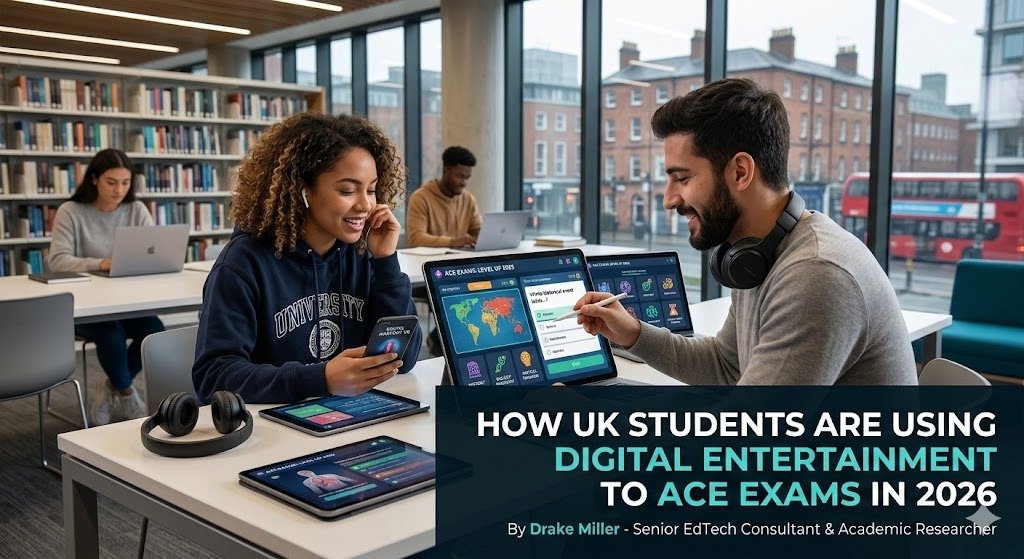
By Drake Miller – Senior EdTech Consultant & Academic Researcher
As an educator who has spent the last decade tracking the intersection of technology and pedagogy in the UK, I have seen many “revolutions” come and go. However, the academic year of 2026 feels fundamentally different. The boundary between “scrolling for fun” and “studying for success” hasn’t just blurred—it has officially vanished.
For Year 13 students sitting their A-Levels in Manchester or undergraduates at the University of Edinburgh, the days of passive learning from static PDFs are over. We are now in the era of high-fidelity, hyper-personalised education. In my recent consultations with UK schools, I’ve observed that the most successful students are those treating their curriculum like a high-end digital subscription.
Here is how digital entertainment is shaping modern education in 2026 and how you can leverage these AI study tools and immersive learning trends to stay ahead of the curve.
1. The “Netflix-ification” of the UK Curriculum
In 2026, the Learning Management Systems (LMS) used by most UK educational institutions have undergone a radical transformation. Influenced by streaming giants like Netflix and Disney+, educational platforms now use Discovery Algorithms to suggest content based on a student’s specific historical performance.
Instead of a rigid, one-size-fits-all syllabus, students now see a personalised dashboard. If a student is struggling with organic chemistry but shows high engagement with interactive video, the system doesn’t just offer more text; it suggests a 3D animated breakdown or a trending “micro-lecture.” For those in creative fields, this might mean the algorithm suggests specific fashion dissertation topics that align with current industry trends and the student’s digital portfolio.
From my perspective, this shift toward On-Demand Education is the greatest equaliser we’ve seen. It allows students to consume “episodes” of learning that fit their specific attention spans and schedules. Whether you are using Google NotebookLM 2.0 to turn your lecture notes into a podcast for your commute or relying on Microsoft Copilot for Students to build a custom revision plan, the academic journey now feels less like a chore and more like a curated content experience.
2. Gamification: Why “Leveling Up” is the New Grade A
The UK has long been a global powerhouse for the gaming industry, and by 2026, those design principles have fully colonised the classroom. Simple leaderboards are no longer enough; we are now seeing Game-Based Learning (GBL) where the curriculum itself is a narrative quest.
For high schoolers, History isn’t just about memorising the dates of the Tudors; it’s about navigating a VR simulation of 16th-century London where every decision impacts the “game” outcome. Research from the Department for Education (DfE) in late 2025 suggested that this level of immersion increases information retention by up to 25% compared to traditional rote learning. By turning complex problem-solving into a “level-up” mechanic, educators are successfully redirecting the dopamine loops usually reserved for video games toward academic mastery and higher UCAS points.
Table: The Evolution of UK Learning (2020 vs. 2026)
| Feature | The 2020 Standard | The 2026 Digital Model |
| Primary Medium | Textbooks & Static PDFs | Interactive VR & AR Modules |
| Learning Path | Linear / Group-paced | Algorithmic / Personalised |
| Support Hours | 9 AM – 5 PM (Human Tutors) | 24/7 (AI-Driven Mentors) |
| Assessment | End-of-year High-Stakes Exams | Continuous Gamified Milestones |
| Credentials | Paper Degrees/Certificates | Blockchain-Verified Digital Badges |
3. AI Tutors: The 24/7 Digital Mentor
One of the most significant changes I’ve documented in 2026 is the normalisation of AI-driven personal tutoring. Influenced by the interactive nature of modern gaming NPCs, AI tutors now act as 24/7 mentors.
For those facing the pressure of A-Levels or complex university projects, the stress of “getting stuck” at 2 AM is a thing of the past. If you find yourself overwhelmed by the sheer scale of a final-year project, accessing professional dissertation writing services at Myassignmenthelp.com ensures that your technical execution matches the high standards expected by Russell Group universities. Tools like ChatGPT-5 and Khanmigo don’t just give answers; they provide hints, offer emotional support, and adapt their tone to the student’s current mood.
See also: How to Know When to Hire a Contractor
4. The Rise of the “Edutainer” and Micro-Learning
Social media platforms like TikTok and Instagram Reels have fundamentally changed how Gen Z and Gen Alpha process information. In 2026, the Micro-learning trend has peaked. Educational content is now delivered in 60-second “knowledge bursts” that are designed to be shareable, fast-paced, and visually engaging.
The rise of the “Edutainer”—academic influencers who combine expert knowledge with the charisma of a YouTuber—has created a new bridge between entertainment and the classroom. If you can learn a dance in 30 seconds, you can learn the basics of macroeconomics in 60. Today’s smart students master the basics of Python coding or complex physics theories during their morning commute on the Tube, simply by following the right creators.
5. Immersive Realities: VR and AR as the New Science Lab
Virtual Reality (VR) and Augmented Reality (AR) have transitioned from expensive gimmicks to essential tools for STEM education in the UK. In 2026, UK schools are increasingly using VR headsets to provide “safe-fail” environments.
I recently visited a medical faculty where students were performing virtual surgeries before ever touching a scalpel. Whether it’s a geography student standing on the edge of a digital erupting volcano or a chemistry student mixing volatile elements in a virtual lab, these experiences provide a level of experiential learning that builds “muscle memory.” For students aiming for top-tier Russell Group universities, mastering these virtual environments is now just as important as mastering the written exam.
6. The Challenge: Managing “Digital Fatigue”
While I am a proponent of these technologies, I must offer a word of caution. Educators and Ofsted inspectors in 2026 are increasingly focused on “Digital Wellbeing.” With the lines blurred between play and work, there is a real risk of screen-induced burnout.
The challenge for modern students is to leverage these high-tech tools without losing the ability to think deeply and critically without a screen. As I always remind my clients, technology should be the co-pilot, not the driver of your education.
Why Professional Academic Synthesis Still Matters
Despite the flashiness of VR and the speed of AI, the core of British education remains the same: the ability to research, synthesise, and present ideas with academic rigour. In an era where “edutainment” can sometimes prioritise style over substance, I’ve noticed many students still struggle with the transition from “learning” to “performing” in high-stakes academic environments.
As assignments become more complex and integrated with technology, many students find themselves needing expert guidance to navigate the transition. Seeking help is not a sign of weakness; it’s a strategy for success. Whether you need assistance with a complex law essay or guidance on a niche research topic for your dissertation, Myassignmenthelp.com provides the human nuance and subject-matter expertise that even the most advanced 2026 AI cannot replicate. Being a “smart student” in 2026 means knowing how to use every tool at your disposal—from AI bots to professional academic consultants.
Looking Ahead: The Future of the UK Degree
As we look beyond 2026, the traditional three-year degree is being challenged by “Stackable Credentials”—digital badges earned through gamified modules and micro-learning platforms. Education is becoming a lifelong, “on-demand” service.
The transformation of education by digital entertainment is an evolution, not a distraction. By making learning more engaging and interactive, we are not just teaching students more—we are teaching them to love the process of learning.
Frequently Asked Questions
Q.1 How do AI study tools help with UK A-Levels in 2026?
AI tools like ChatGPT-5 and specialized EdTech platforms help by providing instant feedback on practice essays and identifying “knowledge gaps” in real-time. This allows students to focus their revision on specific weak areas rather than re-reading entire textbooks.
Q.2 Is “Gamification” effective for University-level subjects?
Yes. In 2026, game-based learning will be widely used in UK medical and engineering degrees. It allows students to simulate high-stakes professional scenarios, improving decision-making skills and practical retention far beyond what traditional lectures offer.
Q.3 What is “Digital Fatigue,” and how can UK students avoid it?
Digital fatigue is the mental exhaustion caused by excessive screen time. UK educators recommend the “20-20-20” rule (every 20 minutes, look at something 20 feet away for 20 seconds) and dedicate specific “analog hours” for deep reading and physical note-taking.
Q.4 Can I use AI to write my UCAS personal statement?
While AI can help you brainstorm ideas and structure your thoughts, UCAS and UK universities use advanced AI-detection and “human-voice” verification in 2026. It is vital to use AI as a tool for guidance while ensuring the final reflection is authentically your own.
About the Author: Drake Miller
Drake Miller is a Senior EdTech consultant and academic researcher with over 12 years of experience navigating the digital transformation of the UK education sector. A former advisor to regional department for education (DfE) pilot programs, Drake specializes in the ethical integration of AI and gamification within A-Level and University curricula.